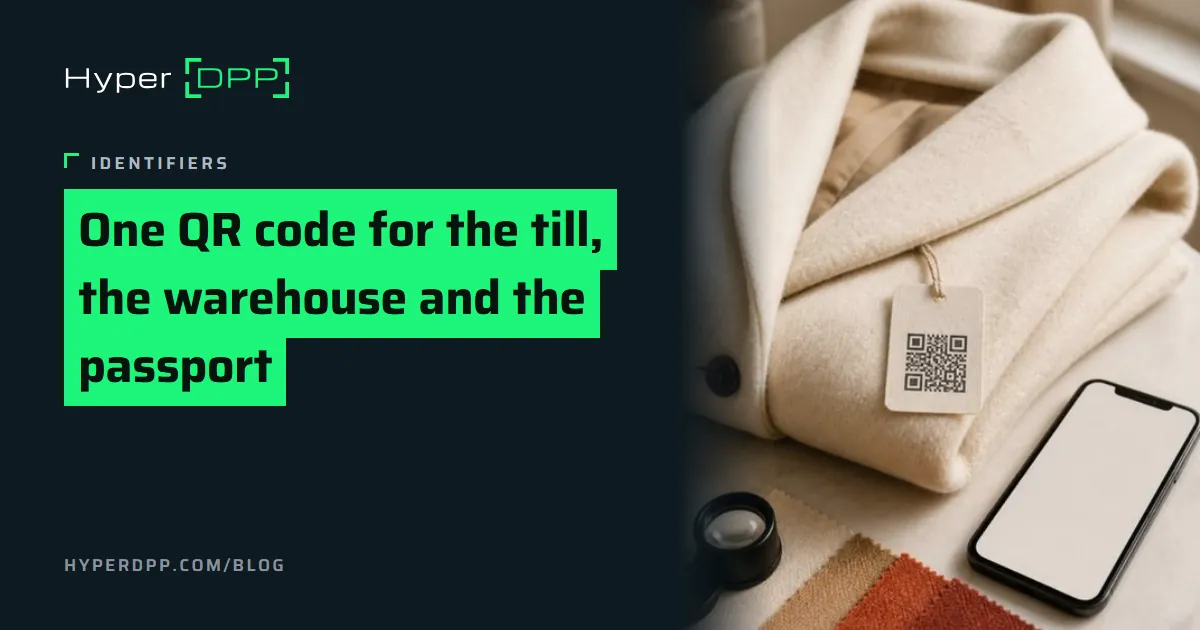
A garment already carries a barcode for the till and often a second code for the warehouse. The digital product passport adds a third need: a code that a consumer, a repairer, a sorter or a customs officer can scan and that leads to the passport. Printing three codes on a care label is not an option.
The GS1 Digital Link standard was designed for exactly this overlap. It turns a product identifier into a web address that a retail scanner can still read as a product number. This article explains how it works, what the ESPR requires and does not yet require, and what to check before you print anything.
What does one code on a garment have to do?
A single code has three jobs. At the till, the scanner needs the Global Trade Item Number (GTIN) to look up the price. In logistics, the same item may need a batch or serial number to be tracked through receiving, returns and recalls. For the passport, a person or a system needs a link that opens the right information for the right audience.
A linear EAN-13 barcode does the first job only. A plain QR code with a marketing URL does the third job only, and its URL usually means nothing to a point-of-sale system. A QR code that encodes a GS1 Digital Link URI can do all three, because the identifier and the web address are the same string.
GS1's 2D Barcode Playbook for Retail Scanners (Release 1.0.1, May 2026) describes an industry goal, called Ambition 2027, that by the end of 2027 all retail point-of-sale systems should be able to read a defined set of 2D barcodes, including a QR Code with GS1 Digital Link URI syntax. The same document says linear barcodes will not go away and that, during the transition, products will carry both the existing linear barcode and a 2D code. Plan for both symbols on your labels for now.
What is a GTIN, and why does every size and colour need its own?
The GTIN is the GS1 number that identifies a trade item. European apparel commonly uses GTIN-13, the number under an EAN-13 barcode. Inside a GS1 Digital Link URI it is always written as 14 digits, with leading zeros as padding.
Apparel teams often think in styles: one design, many colours and sizes. GS1 does not. As the JRC study on passport content for apparel notes, under the GS1 standard every distinct colour and size combination must have its own GTIN. A jacket in three colours and five sizes is fifteen GTINs. If your product data only holds a style number and a size grid, the passport will need the GTIN at variant level before anything else works.
A GTIN on its own identifies a model, not a physical item. That matters for the ESPR, as explained below.
How is a GS1 Digital Link URI built?
The GS1 Digital Link URI Syntax standard (Release 1.7.0, August 2026) defines a path made of GS1 Application Identifiers (AIs) and their values. The GTIN uses AI 01. Optional qualifiers follow in a fixed order: consumer product variant (22), batch or lot (10) and serial number (21). Changing that order is not permitted. Other attributes, such as an expiry date, go in the query string.
Here is a worked example for a navy denim jacket, size M. The GTIN uses the GS1 prefix 952, which GS1 reserves for examples and demonstrations and which must never appear on a real product.
https://id.example.com/01/09521234000174/10/B2611-07/21/A00001234
| Part | Value | Meaning |
|---|---|---|
| Domain | id.example.com | Any domain the brand chooses; the standard does not require a GS1 domain |
| AI 01 | 09521234000174 | GTIN of the navy, size M variant (GTIN-13 padded to 14 digits) |
| AI 10 | B2611-07 | Batch or lot, for example a production order |
| AI 21 | A00001234 | Serial number of this one jacket |
The size L variant would have a different GTIN, for example 09521234000242. A model-level code would stop after the GTIN, and a batch-level code after the batch. Batch and serial values may be up to 20 characters from a restricted character set, so keep them short and avoid characters that need encoding.
GS1 also defines a canonical form on the reference domain id.gs1.org. You do not have to print that domain, but software can convert any conformant URI to it, which is useful when systems need to compare identifiers.
What does a resolver do when someone scans the code?
A resolver is the web service behind the domain. It reads the identifier in the path and decides where to send the request. The GS1-Conformant Resolver Standard (Release 1.2.1, August 2026) sets out the behaviour: every identified item has one default link, and the resolver redirects to it unless the request asks for something more specific.
The request can ask for a link type. GS1's Web Vocabulary lists the types, and it includes gs1:dpp (titled Digital Product Passport), gs1:pip (product information page), gs1:sustainabilityInfo, gs1:certificationInfo, gs1:instructions and gs1:traceability. A recycler's software could request the passport link directly, while a shopper's phone lands on the default page. If no link of the requested type exists, the resolver returns 404 rather than a misleading page.
A client can also ask for the full list of links, called a linkset, instead of a redirect. Language is negotiated from the browser's settings, so a French phone and a German phone can land on different language versions from the same printed code. Which information each audience may see is a separate question; see how passport access layers work.
Should the code identify the model, the batch or the item?
The ESPR leaves this to the product rules. Article 9(2)(d) says each delegated act specifies whether the passport is established at model, batch or item level, and Article 10(1)(f) says the passport data refer to the level the delegated act sets. For textiles, that act has not been adopted. The Commission plans adoption in 2027.
The JRC study on passport content for textile apparel, published in May 2026, gives the clearest indication so far. It proposes batch identifiers as the minimum requirement, filled with batch or model data depending on the field. It assigns fibre composition and recycled content percentage to model level, and producer identification and facility identifiers to batch level, because the same model can be made in different factories. It proposes item-level identifiers (a serialised GTIN or equivalent) on a voluntary basis, and notes that the implications of mixed levels still need analysis. The study states that its contents do not necessarily reflect the Commission's position.
In practice, design your data so a batch-level code works on day one and a serial number can be added later without reprinting a different URI structure. Because the qualifiers sit in a fixed order, a serial number is simply appended after the batch.
| Level | URI ends with | Typical use | Cost driver |
|---|---|---|---|
| Model | /01/{GTIN} | Same code on every item of a variant | Lowest; can be pre-printed |
| Batch | /10/{batch} | Factory, production order, batch test results | Label printed per production order |
| Item | /21/{serial} | Resale, repair history, individual returns | Variable data printing on every label |
What does the ESPR actually say about data carriers and identifiers?
Regulation (EU) 2024/1781 defines a data carrier in Article 2(29) as a linear barcode symbol, a two-dimensional symbol or another automatic identification data capture medium. A unique product identifier, in Article 2(30), is a unique string of characters that identifies a product and also enables a web link. A GS1 Digital Link URI fits both definitions, but the regulation does not name GS1 or QR codes.
Article 10(1) sets the essential requirements. The passport must be connected through a data carrier to a persistent unique product identifier. The data carrier must be physically present on the product, its packaging or documentation accompanying the product. The data carrier and identifier must comply with the standards referred to in Annex III, which names the ISO/IEC 15459 series where relevant and lists the GTIN, as provided for in ISO/IEC 15459-6 or an equivalent, among the possible passport contents.
Article 9(2) leaves the details to each delegated act: which data carrier to use, its layout and positioning, the level of the passport, who may access which data and how long the passport must remain available, which must be at least the expected lifetime of the product. Article 10(3) also requires the operator placing the product on the market to give dealers and online marketplaces a digital copy of the data carrier or identifier within five working days of a request, so online shops can show the passport too.
On standards, the first harmonised DPP standards were referenced in July 2026, including EN 18219 on unique identifiers and EN 18220 on data carriers. What the textile delegated act will prescribe for data carriers is not known yet. See our regulation timeline for the dates that are fixed.
Why does the domain in the link matter if you change vendor?
The URI is printed on the garment and cannot be updated. A jacket sold in 2029 may be resold, repaired or sorted for recycling years later, and the ESPR expects the passport to remain available for at least the product's expected lifetime. The identifier is meant to be persistent.
If the printed domain belongs to a software vendor, every code you print depends on that vendor's redirects for as long as the garments exist. Changing vendor then means either negotiating a permanent redirect or accepting broken links on products already in the market. If the domain is one the brand controls, such as a subdomain of its own website, changing vendor means pointing that subdomain at a new resolver. The codes in circulation keep working.
Three practical rules follow. Register a dedicated subdomain for identifiers and keep it under your own DNS. Make sure any provider can export the full mapping from identifiers to links in an open format. Keep the URI free of vendor-specific path segments. The ESPR also requires a back-up copy of the passport through a passport service provider (Article 10(4)), which protects the data but not a link that points at a domain you do not control. Our 12 questions to ask a DPP vendor cover this in more detail.
How should the code be printed on care labels and hang tags?
The hang tag is removed at home, so it cannot be the only carrier for anything meant to support repair, resale or sorting. The JRC study notes that sorting via the passport requires the data carrier to be available and permanently attached to the garment. A sewn-in care label or a woven or printed label in a seam is the more durable position; the delegated act may set the position, so treat any choice as provisional.
- Keep the URI short. A shorter domain and short batch and serial values mean fewer modules in the QR code, so it can be printed smaller or with more error correction.
- Size by the GS1 specification, not by eye. The GS1 General Specifications set the X-dimension and quiet zone for each symbol in each application. Ask your label supplier to print to them.
- Choose error correction deliberately. Higher QR error-correction levels tolerate more damage, which helps on fabric, but they increase the symbol size.
- Test after washing. Print on the actual ribbon or label material, run the garment's own care cycle, and scan with ordinary phones and a retail scanner afterwards.
- Keep the linear barcode for now. During the transition the till may still read only the EAN-13. Both symbols must carry the same GTIN.
- Print variable data only where needed. A batch-level code can be printed per production order; a serial number needs variable data printing at the label supplier.
- Add a short human-readable line. Text such as the product name and a prompt to scan helps people who do not recognise the symbol.
Label suppliers will carry much of this work. Our page for label partners explains how printed codes connect to passport data.
What should you do first?
Check that every colour and size has a GTIN and that your production orders carry a batch reference. Decide the identifier domain now, before any code is printed. Then run a small wash test with your label supplier on one product.
HyperDPP publishes passports behind a GS1 Digital Link QR code, with a multilingual passport page, four access layers and GS1 linkset output, and lets you export every product, field and version in open formats such as JSON-LD and CSV. To see the result on your own data, you can turn a CSV into a passport. Regulatory information last checked November 2026.
Frequently asked questions
Can one QR code work at the till and for the digital product passport?
Yes, if it encodes a GS1 Digital Link URI. A point-of-sale scanner that supports 2D codes extracts the GTIN from the URI, while a phone opens the same URI as a web address and a resolver sends it to the right page.
Does the ESPR require a QR code?
No. The ESPR defines a data carrier as a linear barcode, a two-dimensional symbol or another automatic identification medium, and leaves the choice to each delegated act. The textile delegated act had not been adopted as of November 2026.
Do I need a separate GTIN for every size and colour?
Yes. Under GS1 rules each colour and size combination is a separate trade item with its own GTIN, even if your PLM system groups them under one style.
Should the passport be at item level with serial numbers?
Not necessarily. The ESPR lets the delegated act choose model, batch or item level. The JRC study for apparel proposes batch identifiers as the minimum and item-level identifiers as voluntary, but the final rule is not decided.
Sources
- Regulation (EU) 2024/1781 (ESPR), EUR-Lex
- GS1 Digital Link Standard: URI Syntax
- GS1-Conformant Resolver Standard
- GS1 Web Vocabulary: link types
- GS1 2D Barcode Playbook for Retail Scanners (May 2026)
- JRC: Study on DPP content for textile apparel products under ESPR (May 2026)
Regulatory information last checked November 2026. This article is general information, not legal advice.